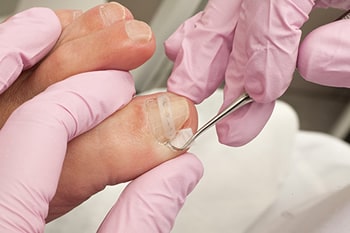
Ingrown Toenails
Ingrown toenails can form when the side of a toenail begins to grow into the flesh surrounding the nail. As a result, the affected toe—most commonly the big toe—may become red, swollen, painful, and—in severe cases—infected.
What Causes an Ingrown Toenail?
There are many reasons why an ingrown toenail may develop. Improperly cutting your toenails is a major cause of ingrown toenails. If toenails aren’t cut straight across or are cut too short, the likelihood of getting an ingrown toenail may increase. Other causes include having unusually curved toenails, wearing shoes that don’t give your toes an ample amount of space, and hereditary factors. Injuring the toe by stubbing it or having an object fall on it may also lead to ingrown toenails. If left untreated, an ingrown toenail can lead to further complications with the foot.
Ingrown Toenail Prevention and Diabetes
If you are someone who has diabetes, it’s extremely important to remain mindful of ingrown toenail prevention, as minor cuts or simple scrapes can lead to serious complications. You can prevent ingrown toenails by ensuring toenails are straight across and at a moderate length, wearing shoes that fit properly, and checking feet daily for signs of foot issues.
Ingrown Toenail Treatment Options
Treatment for an ingrown toenail will vary on a case by case basis. One form of treatment requires lifting the ingrown nail and placing a splint or piece of cotton underneath. Another method for a more severe case would involve partially removing the nail. For cases that need extreme care, the nail itself and tissue would have to be removed.
Talk to a Scottsdale Podiatrist
If you’d like more information about ingrown toenails, we recommend you consult with a podiatrist who can give you a proper diagnosis and go over your treatment options.
FAQ
1. What is an ingrown toenail?
An ingrown toenail develops when the edge of the nail grows into the skin beside it, most often on the big toe. The result is typically pain, redness, and swelling, and an infection can follow if bacteria reach the broken skin.
2. What causes ingrown toenails?
The usual causes are trimming the nails incorrectly, wearing shoes that fit too tightly, injuring the toe, or simply inheriting a nail shape that curves. Cutting nails too short or rounding off the corners makes it far more likely that the nail will grow into the skin.
3. Who is most likely to get ingrown toenails?
Ingrown toenails can affect anyone, though they turn up most often in teenagers, athletes, and people who wear tight shoes or spend long hours on their feet. Anything that causes the feet to swell, or that thickens the nails, also raises the risk.
4. How can I tell if an ingrown toenail is infected?
Watch for redness that spreads, warmth around the toe, swelling, pus draining from the nail edge, and pain that keeps intensifying. If the area becomes very tender or shows no sign of improving, treatment may be needed to stop the infection from spreading further.
5. Can ingrown toenails heal without treatment?
A mild ingrown toenail may settle down with careful home care, such as soaking the foot in warm water and keeping pressure off the toe. If the pain continues or signs of infection appear, professional treatment is the safer route and helps prevent complications.
6. Is it safe to cut an ingrown toenail at home?
Cutting an ingrown toenail yourself often makes the situation worse or introduces an infection, particularly when the nail is embedded deeply in the skin. Having it treated professionally means the nail is dealt with safely and lowers the likelihood that the problem returns.
7. How are ingrown toenails treated?
Treatment varies with how severe the problem is, and may involve soaking the foot, taking pressure off the toe, or trimming the nail correctly. When an ingrown toenail persists or becomes infected, a minor in-office procedure to remove part of the nail is often what relieves the pain.
8. When should I see a podiatrist for an ingrown toenail?
Book an appointment if the toenail is very painful, if it is infected, or if the same nail keeps becoming ingrown. Anyone with diabetes, reduced circulation, or a nerve condition should be seen early, since these make serious complications more likely.
9. Where can I get treatment for an ingrown toenail in Scottsdale?
Arcadia Foot and Ankle treats ingrown toenails at both of our Scottsdale offices. The South Scottsdale office is at 6401 E. Thomas Road, Suite 106, Scottsdale, AZ 85251, telephone (602) 955-3338. The North Scottsdale office is at 10900 N. Scottsdale Road, Suite 101, Scottsdale, AZ 85254, telephone (480) 483-9000. You can call either location directly or request an appointment online.
10. Which Scottsdale office should I visit for ingrown toenail treatment?
Both Scottsdale offices treat ingrown toenails, so choose whichever is more convenient. The South Scottsdale office on E. Thomas Road is the closer option for patients in Old Town, Arcadia, and central Scottsdale. The North Scottsdale office on N. Scottsdale Road is easier to reach from the 101, Kierland, and Paradise Valley. Our physicians are bilingual in English, Spanish, and Portuguese. If you are not sure which to choose, call either office and our staff can point you to the right one.


